


Jadeology Episode 18 — When Were Words First Incised on Ancient Jade?
- Kako Crisci
- Jul 22, 2025
- 3 min read

Words are a symbol of the stage of development of our civilization. They carried the same function as the designs carved into jade artifacts: recording our distant ancestors’ identities, thoughts, and wishes, and reflecting the culture of their time.
Just as the discovery of Shang oracle bones revealed words incised on bone to record the Shang people’s thoughts, prayers, and important events, scholars agree that characters were widely used in the Shang Dynasty about 3,000 years ago. Many scholars argue that writing itself is a symbol of civilization. From the maturity of the oracle bone script, we can reasonably assume that writing must have existed long before the Shang, for the script to have reached such a structured and sophisticated form. But how far back can we truly trace the origins of these early characters?
Since the discovery of the Shang oracle bones nearly a century ago, the study of the earliest development of ancient writing remains an underexplored field.
One reason for this gap is our lack of systematic understanding of ancient jade. Ancient writing was often painted or carved on wood, but wood rarely survives for thousands of years. In contrast, words carved into jade remain unchanged for millennia — yet because jade has long been misunderstood, inscriptions on jade have often been overlooked or dismissed. This is why jadeology holds a vital key to understanding ancient achievements, including the origins of written characters that honestly reflected people’s thoughts at the time.
The Liangzhu culture, which existed at least 2,000 years before the Shang Dynasty, offers important clues. On Liangzhu jade, we frequently encounter characters incised directly into the surface. The Liangzhu Museum even has a dedicated section for words scholars have found carved on Liangzhu jade.
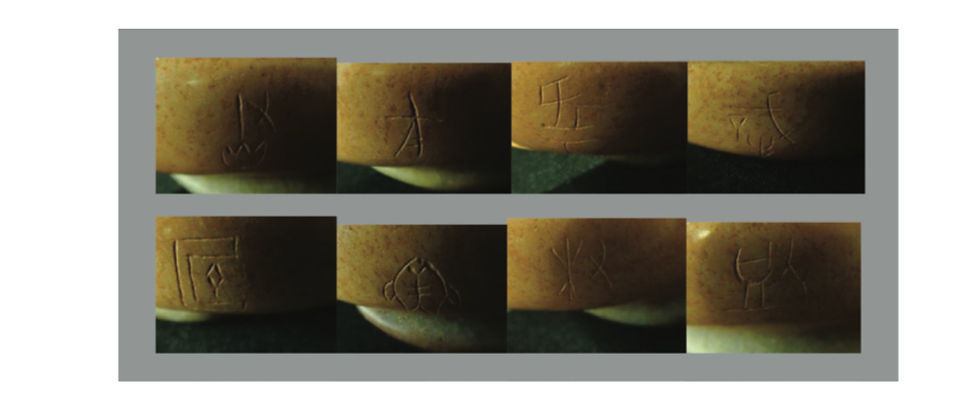
One magnificent example is a jade bracelet from the Liangzhu culture. This bracelet bears several individual characters — enough to suggest they may form a complete sentence, carrying the good wishes of the Liangzhu people.
Let’s apply our Four-Point Checkup method:
Material: White jade, partially translucent.
Stain and Patina: Fully stained to a creamy yellow with orange-yellow spots throughout. A deep, rich patina perfectly matches its age.
Design: A rounded, finely smoothed edge makes the bracelet comfortable to wear. Eight characters are evenly incised on the jade surface — unlike the typical divine face motif seen on most Liangzhu jade.
Craftsmanship: The inner side is softly rounded inward; although the edge has some uneven spots, it is well polished overall. The Liangzhu people favored the incising method — instead of carving divine faces, they incised words, using the same delicate carving technique.
The bracelet’s material, stains, and patina confirm it is undoubtedly a Liangzhu piece. Yet it expands our understanding of Liangzhu jade. Toward the end of the Liangzhu culture, jade designs became simpler, surfaces plainer, and instead of elaborate motifs, more words appeared on single pieces. Unlike the typical one or two characters on earlier Liangzhu jade, here we see eight characters together — likely connected in meaning, forming a sentence to express a good wish.
Although we cannot yet fully decipher all these words, the fact that multiple characters were incised shows clearly that written language existed as far back as the Liangzhu culture. This bracelet is living proof that, for the Liangzhu people, words carried the same spiritual function as divine motifs — serving as vessels for their wishes, prayers, and protection.
Although on some Hongshan jade pieces we have found a single word, such as “之,” we cannot yet say with certainty whether this was truly a word or simply a symbolic mark. With only a single character, its exact meaning remains unclear — and we need more evidence to confirm whether the Hongshan people were the first to inscribe words or characters on jade. But for now, we can be sure that the Liangzhu people carved words — and even possible sentences — onto their jade. This pushes the history of Chinese writing back at least 2,000 years earlier than the commonly accepted date of the Shang oracle bones.



Comments